| Signal standard | HDMI 2.0b · DisplayPort 1.4a Alt Mode on the USB-C inputs (the laptop's USB-C port must support DP Alt Mode) |
| HDCP | HDCP 2.3 |
| Maximum resolution | Up to 4096 × 2160 @ 60 Hz, input and output |
| Scaling | Each output can downscale 4K to 1080p |
| Bandwidth | 18 Gbps video · USB 3.2 Gen 1 (5 Gbps) |
| Colour space | RGB · YCbCr 4:4:4 / 4:2:2 / 4:2:0 |
| Colour depth | 8/10/12-bit · 8-bit at 4K60 4:4:4 |
| HDR | HDR10, HDR10+, Dolby Vision, HLG |
| CEC | CEC control of the display and external devices |
| HDMI audio formats | LPCM, Dolby Digital/Plus/EX, Dolby TrueHD, Dolby Atmos, DTS, DTS-EX, DTS-96/24, DTS High Res, DTS-HD Master Audio, DSD |
| Audio de-embedding | Analogue in embeds into HDMI or USB audio, or HDMI or USB audio de-embeds to analogue out — not both at once |
| Analogue audio input | Balanced or unbalanced stereo, 5-pin 3.5 mm Phoenix · 20 kΩ balanced / 10 kΩ unbalanced · max 8.2 dBu (2 Vrms) balanced |
| Analogue audio output | Balanced or unbalanced stereo, 5-pin 3.5 mm Phoenix · 600 Ω balanced / 300 Ω unbalanced · max 8.2 dBu (2 Vrms) balanced, 2.2 dBu (1 Vrms) unbalanced |
| Analogue performance | In: 20 Hz–20 kHz ±0.5 dB, THD+N < 0.01 % · Out: 20 Hz–20 kHz ±1 dB, THD+N < 0.067 % · dynamic range and S/N > 90 dB · delay < 1 ms |
| Other audio formats | Analogue: LPCM 2-channel, 32–192 kHz |
| Network | Dual 1G Ethernet with 802.1X and VLAN |
| Passive cable reach | USB 3.2 up to 1.5 m · HDMI up to 3 m |
| Inputs | 2 × HDMI · 2 × USB-C (DP Alt Mode, USB 3.2 Gen 1, 1G Ethernet; 100 W charging total, 50 W per port) · analogue L/R in |
| Outputs | 2 × HDMI · analogue L/R out |
| USB | Hosts: 2 × USB-C inputs · USB-C host (data only) · USB-B host · Devices: 1 × USB-C + 2 × USB-A (USB 3.2 Gen 1, 5 V / 1.5 A) |
| Network ports | 2 × RJ45 (1G) · by default ETHERNET 1 for control, ETHERNET 2 for laptops on USB-C; switch mode gives both ports both roles |
| Control ports | RS-232 (3-pin Phoenix) · IR out (3.5 mm) · GPIO (6-pin Phoenix) · USB-C service port |
| Control methods | Front-panel buttons, RS-232, TCP/IP, web GUI |
| EDID management | Built-in EDID list, copy from either HDMI output or both combined, and two user-defined uploads (.bin) |
| IR | IR learning window; IR out 5 Vp-p, 20–60 kHz |
| Switching | Automatic (signal or 5 V detection) or manual |
| Operation | Displays power on and off with the switcher: CEC on either output; IR or RS-232 on one output only |
| Power supply | 24 V DC, 7.5 A · 100–240 V AC adapter |
| Power consumption | 41 W · 149 W with 100 W USB-C charging |
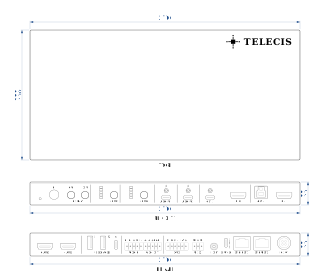
| Dimensions (W × D × H) | 270 × 130 × 23 mm |
| Weight | 890 g |
| Housing | Metal, black |
| Mounting | Desk (rubber feet) or mounting ears |
| Operating temperature | 0 to 40 °C |
| Storage temperature | −20 to 60 °C |
| Humidity | Operating 20–80 % · storage 10–90 % RH, non-condensing |
| ESD protection | ±8 kV air · ±4 kV contact (IEC 61000-4-2) |
| Compliance | Designed for global compliance — CE, FCC, RoHS, and regional certifications, as applicable. |
| Warranty | 3 years |
| In the box | Switcher · 24 V / 7.5 A power supply · IR blaster cable (1.5 m) · 3-pin, 2 × 5-pin and 6-pin 3.5 mm Phoenix connectors · 4 rubber feet · 2 mounting ears · screws |